
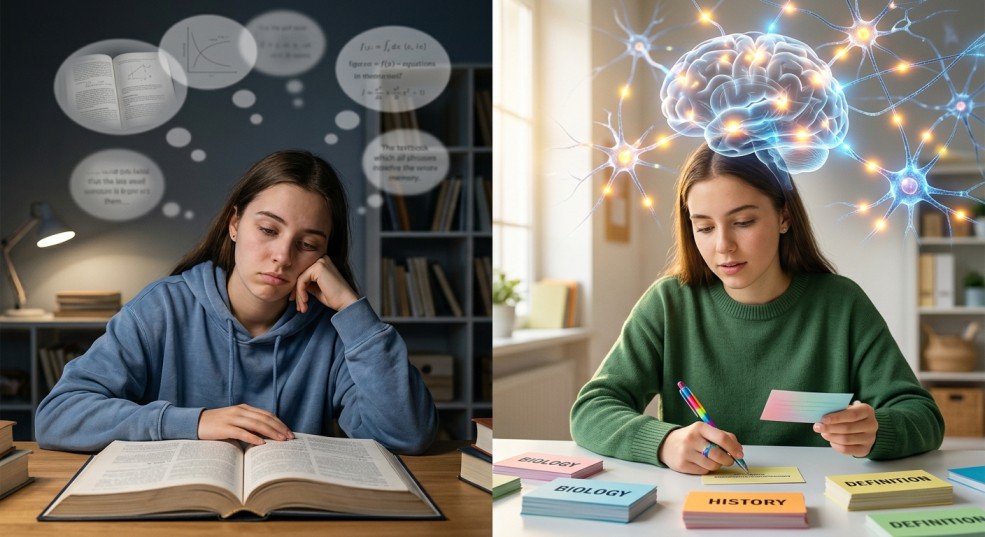

Introduction: The Frustration Every Student Knows
You study for hours.
You read the same chapter again and again.
It feels like you understand everything.
But when the exam comes:
👉 your mind goes blank
👉 answers feel unfamiliar
👉 everything seems forgotten
This is one of the most common problems in studying:
👉 You think reading is learning—but it is not.
Most students rely on re-reading because it feels safe and easy. But science tells a different story.
There are two major study methods:
✔ Re-reading (passive learning)
✔ Active Recall (active learning)
And only one of them actually builds strong memory.
What is Re-reading?
Re-reading means:
👉 going through the same material again and again
Example:
- reading textbook multiple times
- reviewing notes repeatedly
- scanning highlighted text
Why Students Love Re-reading
Because it feels:
✔ familiar
✔ comfortable
✔ low effort
When you re-read:
- things “look familiar”
- you feel like you understand
- you get false confidence
👉 But familiarity is not memory.
The Big Problem with Re-reading
Re-reading creates an illusion:
❌ “I know this topic”
But in reality:
👉 you are only recognizing information, not recalling it
And exams don’t test recognition—they test recall.
What is Active Recall?
Active Recall is the opposite of re-reading.
Instead of looking at information:
👉 you try to retrieve it from memory
Example:
- closing your book
- asking yourself questions
- writing answers from memory
Simple Definition
👉 Active Recall = forcing your brain to remember without help
Why Active Recall Feels Hard
Because:
- your brain must work
- you can’t rely on text
- you may forget at first
But that difficulty is exactly what makes it powerful.
THE SCIENCE BEHIND MEMORY
1. The Brain is Not a Recorder
Your brain does NOT store information like a video.
Instead:
✔ it builds connections
✔ it strengthens pathways
✔ it removes unused information
2. Forgetting is Normal
You forget because:
- brain filters useless data
- weak memories fade
- unused information disappears
👉 This is called the Forgetting Curve
3. Re-reading Fails Because of Recognition
When you re-read:
- information feels familiar
- brain thinks “I know this”
But:
❌ familiarity ≠ recall ability
4. Active Recall Builds Strong Memory Paths
When you force recall:
✔ brain struggles
✔ connections strengthen
✔ memory becomes permanent
THE FORGETTING CURVE EXPLAINED
What is the Forgetting Curve?
It shows:
👉 how quickly we forget information without review
Typical pattern:
- 20 minutes → small loss
- 1 day → major loss
- 1 week → most gone
Why Re-reading Doesn’t Fix It
Because:
❌ it does not test memory
❌ it does not strengthen recall
❌ it only refreshes recognition
Why Active Recall Breaks the Curve
Because:
✔ it forces retrieval
✔ it strengthens memory
✔ it slows forgetting
ACTIVE RECALL VS RE-READING
Re-reading Method
✔ passive
✔ easy
✔ familiar
But:
❌ weak retention
❌ false confidence
❌ poor exam performance
Active Recall Method
✔ active
✔ effort-based
✔ slightly difficult
But:
✔ strong memory
✔ long-term retention
✔ better exam results
WHY STUDENTS FAIL DESPITE STUDYING
Mistake 1: Mistaking Reading for Learning
Reading feels like studying, but:
👉 it is only exposure, not mastery
Mistake 2: No Self-Testing
Without testing:
❌ you never check real knowledge
Mistake 3: Over-reliance on Notes
Notes are helpful, but passive use leads to weak memory.
HOW ACTIVE RECALL WORKS IN THE BRAIN
Step 1: Attempt to Remember
Brain searches memory storage.
Step 2: Struggle Happens
This struggle is important:
👉 it signals learning effort
Step 3: Neural Pathways Strengthen
Each attempt strengthens memory circuits.
Step 4: Future Recall Becomes Easier
Next time:
✔ faster recall
✔ stronger memory
WHY EFFORT = MEMORY
A key scientific principle:
👉 The more effort you use to retrieve, the stronger memory becomes
Easy learning = weak memory
Hard retrieval = strong memory
HOW TO USE ACTIVE RECALL EFFECTIVELY
1. Close Your Book
After studying:
👉 shut it completely
2. Ask Questions
Examples:
- What did I just learn?
- Can I explain it?
- What are the key points?
3. Write From Memory
Don’t look at notes.
4. Check Mistakes
Then compare:
✔ what you remembered
❌ what you missed
5. Repeat
This is where learning becomes permanent.
ACTIVE RECALL TECHNIQUES
1. Flashcards
- question on one side
- answer on other
2. Blurting
- write everything from memory
3. Self Quizzing
- test yourself regularly
4. Teaching Method
- explain topic to someone else
WHY RE-READING FEELS EFFECTIVE (BUT ISN’T)
Illusion of Fluency
When you re-read:
- text feels smooth
- brain feels familiar
But:
👉 fluency is not understanding
Comfort Trap
Re-reading is easy:
- no pressure
- no effort
- no discomfort
But:
👉 no discomfort = no deep learning
HOW TOP STUDENTS STUDY DIFFERENTLY
Average Students
❌ read repeatedly
❌ highlight everything
❌ feel confident too early
Top Students
✔ test themselves
✔ recall actively
✔ practice retrieval
COMBINING ACTIVE RECALL WITH OTHER METHODS
Best learning system:
✔ Active recall
✔ Spaced repetition
✔ Feynman technique
✔ Practice questions
REAL IMPACT ON EXAM PERFORMANCE
Students using active recall:
✔ remember more
✔ revise faster
✔ reduce stress
✔ write better answers
HOW TO SWITCH FROM RE-READING TO ACTIVE RECALL
Step 1: Accept discomfort
It will feel harder initially.
Step 2: Start small
Try 10–15 minutes daily.
Step 3: Increase gradually
Make it your main study method.
FINAL STUDY STRATEGY
Instead of:
❌ read → reread → highlight
Do this:
✔ learn → close book → recall → test → revise
CONCLUSION: THE SCIENCE IS CLEAR
Re-reading feels safe but is scientifically weak.
Active Recall feels hard but is scientifically powerful.
Final Truth
👉 You don’t learn by seeing information—you learn by retrieving it.
Final Line to Remember
👉 “If you can’t recall it without looking, you don’t truly know it yet.”
🧠 ACTIVE RECALL vs RE-READING: THE SCIENTIFIC REASON YOU’RE FORGETTING EVERYTHING
❓ FAQ’S (SMART LEARNING SCIENCE GUIDE)
❓ FAQ 1: WHAT IS ACTIVE RECALL?
✔ ANSWER:
ACTIVE RECALL IS A LEARNING METHOD WHERE YOU:
👉 TEST YOURSELF WITHOUT LOOKING AT NOTES
EXAMPLES:
- CLOSE BOOK AND TRY TO REMEMBER
- WRITE ANSWERS FROM MEMORY
- QUIZ YOURSELF
👉 IT FORCES YOUR BRAIN TO RETRIEVE INFORMATION
❓ FAQ 2: WHAT IS RE-READING?
✔ ANSWER:
RE-READING IS WHEN YOU:
👉 READ YOUR NOTES OR BOOK AGAIN AND AGAIN
IT FEELS EASY, BUT:
- YOUR BRAIN DOES NOT GET TESTED
- YOU THINK YOU KNOW IT, BUT YOU ACTUALLY DON’T
👉 IT CREATES AN “ILLUSION OF LEARNING”
❓ FAQ 3: WHY AM I FORGETTING EVERYTHING AFTER READING?
✔ ANSWER:
BECAUSE READING IS PASSIVE.
YOUR BRAIN:
❌ DOES NOT PRACTICE RETRIEVAL
❌ DOES NOT STRUGGLE TO REMEMBER
❌ DOES NOT BUILD STRONG MEMORY PATHS
👉 NO STRUGGLE = WEAK MEMORY
❓ FAQ 4: WHY IS ACTIVE RECALL SCIENTIFICALLY BETTER?
✔ ANSWER:
BECAUSE IT USES “RETREIVAL PRACTICE.”
IT:
✔ STRENGTHENS MEMORY CONNECTIONS
✔ IMPROVES LONG-TERM RETENTION
✔ MAKES EXAM ANSWERS FASTER
✔ REDUCES FORGETTING
👉 THE MORE YOU STRUGGLE TO REMEMBER, THE STRONGER YOUR MEMORY BECOMES
❓ FAQ 5: HOW DO I PRACTICE ACTIVE RECALL?
✔ ANSWER:
USE THESE METHODS:
🟢 CLOSE BOOK AND WRITE EVERYTHING YOU KNOW
🟢 USE FLASHCARDS
🟢 ASK YOURSELF QUESTIONS
🟢 TEACH THE TOPIC TO SOMEONE
👉 TEST YOURSELF, DON’T JUST READ
❓ FAQ 6: IS RE-READING COMPLETELY USELESS?
✔ ANSWER:
NOT COMPLETELY ❌
BUT:
✔ IT SHOULD BE USED ONLY FOR FIRST UNDERSTANDING
✔ NOT FOR FINAL REVISION
👉 REAL LEARNING HAPPENS IN ACTIVE RECALL
❓ FAQ 7: WHICH ONE SHOULD I USE FOR EXAMS?
✔ ANSWER:
CLEAR ANSWER:
👉 ACTIVE RECALL = BEST FOR EXAMS ✔
👉 RE-READING = SUPPORT METHOD ONLY
💡 FINAL TIP:
DON’T CONFUSE FAMILIARITY WITH MASTERY.
👉 JUST BECAUSE SOMETHING FEELS EASY TO READ DOES NOT MEAN YOU CAN REMEMBER IT IN EXAM.
WHEN YOU SWITCH FROM RE-READING TO ACTIVE RECALL, YOU STOP FORGETTING AND START SCORING MORE.
IF YOU WANT, I CAN ALSO MAKE:
📌 “TOP 10 SCIENTIFIC STUDY METHODS THAT ACTUALLY WORK”
📌 “HOW TO STOP FORGETTING WHAT YOU STUDY”
📌 “EXAM REVISION PLAN USING ACTIVE RECALL”