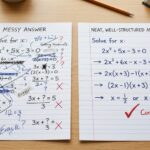


Introduction
Exams don’t just test your knowledge—they test your attention, discipline, and awareness under pressure. You might prepare for weeks, understand every concept, and still lose marks for reasons that feel almost unfair. A missed unit. A skipped question. A careless calculation.
That’s where toppers stand apart.
They don’t just write answers—they protect their marks. And they do that through one powerful habit: smart answer sheet reviewing.
If you’ve ever come out of an exam hall and suddenly realized, “Oh no, I made such a silly mistake,” then you already understand how painful avoidable errors can be. The good news? These mistakes are not about intelligence—they are about process. And once you fix the process, your marks improve almost instantly.
Why Reviewing Your Answer Sheet Is a Game-Changer
Most students treat reviewing as optional. Toppers treat it as non-negotiable.
Think about it this way:
- Writing answers earns marks
- Reviewing answers saves marks
And in competitive exams, saving marks is just as important as earning them.
A proper review can easily improve your score by 5 to 10%, sometimes even more. Not because you learned something new—but because you avoided losing what you already knew.
That’s the real difference.
The Topper Mindset: Become Your Own Examiner
When toppers finish writing, they don’t relax. They switch roles.
They stop being a student and start thinking like a checker:
“If I were the examiner, where would I cut marks?”
This shift changes everything.
Instead of passively reading your answers, you actively hunt for mistakes. You assume there are errors—and you go find them before anyone else does.
Step 1: Always Save Time for Review
This is where most students fail.
They keep writing till the last second and leave zero time to check their work.
That’s a risky move.
A smarter strategy:
- Reserve 10–15 minutes for review in shorter exams
- Reserve 15–20 minutes in longer papers
To make this possible, train yourself to:
- Write to the point
- Avoid unnecessary long explanations
- Keep your pace controlled
Bold truth:
An unfinished review can cost you more marks than an unfinished answer.
Step 2: Don’t Review Randomly—Follow a System
Jumping randomly between answers wastes time and energy.
Instead, follow this sequence:
1. Objective Section (MCQs)
Quick to check, easy to fix, high accuracy impact.
2. Short Questions
Focus on keywords and direct answers.
3. Long Questions / Essays
Check structure, clarity, and completeness.
This order ensures you cover maximum marks in minimum time.
Common Silly Mistakes That Destroy Scores
Now let’s talk about the real issue: the mistakes that quietly reduce your marks.
1. Misreading the Question
This happens more often than students admit.
You might:
- Write advantages instead of disadvantages
- Solve correctly—but for the wrong variable
- Ignore key instructions like “briefly” or “in detail”
During review, ask yourself:
👉 “Did I actually answer what was asked?”
Because even a perfect answer is useless if it doesn’t match the question.
2. Skipping a Question by Accident
It sounds unlikely—but in exam pressure, it happens.
Pages flip. Questions get missed. Time runs fast.
During review:
- Scan every page
- Match question numbers
- Ensure nothing is left blank
Simple habit: Put a small tick next to each attempted question.
3. Calculation Mistakes
These are silent killers in subjects like Math and Science.
You may understand the concept perfectly—but one small error can ruin everything.
Common issues:
- Sign mistakes (+ / -)
- Wrong multiplication
- Copying numbers incorrectly
During review:
👉 Recheck final answers first
👉 Then quickly scan important steps
Bold reminder:
Concept gives you marks—but accuracy keeps them.
4. Missing or Incorrect Units
Writing “10” instead of “10 m/s” can cost marks.
Units matter. They show completeness and understanding.
Always check:
- Final numerical answers
- Conversion steps
5. Weak Presentation
Even correct answers can lose marks if they look messy.
Examiners check dozens of papers. A clear answer stands out instantly.
During review, improve:
- Underline key terms
- Add headings
- Label diagrams
You don’t need to rewrite—just refine what’s already there.
6. Spelling and Terminology Errors
This matters more than students think.
Especially in:
- English
- Biology
- Theory subjects
Wrong spelling of key terms can reduce clarity.
During review:
- Focus on headings
- Scan technical words
Strong presentation builds trust with the examiner.
7. Missing Steps in Solutions
In many subjects, marks are given for steps—not just answers.
If you jump directly to the result, you risk losing marks.
During review:
- Add skipped steps
- Clarify rough work
8. Wrong Question Numbering
This creates confusion and can even lead to unchecked answers.
Check:
- Every number matches the question paper
- No duplication or skipping
Smart Review Techniques Used by Toppers
Toppers don’t just “read again”—they use techniques.
1. Reverse Reading
Instead of reading normally:
- Start from the last answer
- Move backward
This breaks your brain’s familiarity and helps spot hidden mistakes.
2. Line-by-Line Tracking
Use your finger or pen while reading.
It slows you just enough to:
- Catch small errors
- Avoid skipping lines
3. Final Answer Focus
Marks are often awarded for final results.
So always double-check:
- Final values
- Conclusions
- Key statements
4. Review Weak Questions First
Start with the answers you were unsure about.
That’s where mistakes are most likely hiding.
What You Should NOT Do During Review
Many students waste their review time doing the wrong things.
Avoid this:
- ❌ Rewriting entire answers
- ❌ Changing answers without reason
- ❌ Panicking after spotting one mistake
- ❌ Overchecking already correct parts
Your goal is simple:
👉 Fix mistakes, not create new ones
Mental Control During Review
Your mindset matters just as much as your method.
Stay calm.
Even if you find a mistake:
- Fix it
- Move on
Don’t let one error affect your confidence.
Bold mindset:
One correction can save marks—you’re still improving.
Practice This Before Exams
Reviewing is a skill, not luck.
While practicing past papers:
- Simulate real exam timing
- Leave review time
- Analyze your errors
Over time, you’ll:
- Spot mistakes faster
- Reduce careless errors
- Gain confidence
Quick Final Checklist
Before submitting, confirm:
✔ All questions attempted
✔ No numbering mistakes
✔ Calculations checked
✔ Units written
✔ Key points highlighted
✔ Diagrams labeled
✔ Final answers verified
Final Words
At the end of the day, exams are not just about knowledge—they are about execution.
Two students can study the same material. One scores higher. Why?
Because one of them takes the time to review, correct, and secure marks.
That’s the habit you need to build.
So next time you finish your paper, don’t rush to submit.
Pause. Review. Think like a topper.
Because sometimes, the difference between average and excellent is not what you wrote—
but what you fixed before handing it in.
Conclusion
In the end, success in exams is not only about how much you study, but how wisely you handle your paper in those final moments. Many students lose marks not because they don’t know the answers, but because they fail to catch small, avoidable errors. This is exactly where toppers gain their edge.
They understand one simple truth: writing answers earns marks, but reviewing answers protects them. By taking a few extra minutes to carefully go through their sheet, they eliminate mistakes, improve clarity, and make their work examiner-friendly.
If you build this habit, you’ll start noticing a clear difference in your performance. Your answers will become more accurate, your presentation will improve, and most importantly, your confidence will grow with every exam.
So next time, don’t rush to submit your paper. Stay focused till the very end and give your answers the attention they deserve.
Because sometimes, the difference between average marks and top results is just a few corrected mistakes.
🧠 HOW TO REVIEW YOUR ANSWER SHEET LIKE A TOPPER
(COMMON SILLY MISTAKES TO CATCH — FAQ STYLE, BIG FORMAT)
❓ Q1: ANSWER SHEET REVIEW KARNA KYUN IMPORTANT HAI?
✔ Review se aap apni small mistakes ko catch kar sakte ho
✔ Bohat dafa marks “knowledge ki wajah se nahi, silly errors ki wajah se” cut hote hain
👉 TOPPER DIFFERENCE:
KNOWLEDGE + ACCURACY + PRESENTATION
❓ Q2: REVIEW KAB KARNA CHAHIYE?
✔ LAST 5–10 MINUTES ME
✔ Jab paper complete ho jaye
👉 RULE:
🟢 “FIRST COMPLETE, THEN CHECK”
❓ Q3: SAB SE COMMON SILLY MISTAKES KYA HOTI HAIN?
❌ 1. CALCULATION ERRORS
- Simple addition/subtraction mistake
- Wrong sign (+ / -)
❌ 2. UNITS MISS KARNA
- cm, kg, m/s likhna bhool jana
👉 MARKS LOSS GUARANTEED
❌ 3. QUESTION MISREAD KARNA
- “Explain” ko “define” samajh lena
- Key word miss karna
❌ 4. STEPS SKIP KARNA
- Final answer sahi, lekin steps missing
👉 MARKS CUT HOTE HAIN
❌ 5. NEATNESS ISSUE
- Illegible writing
- Overwritten answers
❓ Q4: TOPPER REVIEW STRATEGY KYA HOTI HAI?
✔ Step-by-step check:
🟢 STEP 1: QUESTION ALIGNMENT
👉 Har answer question se match karta hai ya nahi?
🟡 STEP 2: CALCULATION CHECK
👉 Numbers aur signs verify karo
🔵 STEP 3: UNITS + LABELS
👉 Har numerical answer ke saath unit check karo
🔴 STEP 4: FINAL READ
👉 Poora answer quickly read karo
❓ Q5: REVIEW KITNA TIME LENA CHAHIYE?
✔ 5–10 minutes enough
✔ Bohat zyada time = overthinking
👉 SMART RULE:
⏱ “FAST BUT CAREFUL CHECK”
❓ Q6: KYA HAR QUESTION RECHECK KARNA ZAROORI HAI?
✔ IMPORTANT QUESTIONS = YES
✔ EASY QUESTIONS = QUICK SCAN
✔ TIME SHORT HO TO HIGH-MARK QUESTIONS PRIORITY
❓ Q7: AGAR MISTAKE MIL JAYE TO KYA KARNA CHAHIYE?
✔ Calmly correct karo
✔ Overwriting avoid karo
✔ Clean correction use karo
👉 PANIC = NEW MISTAKES
❓ Q8: PRESENTATION KA REVIEW ME ROLE KYA HAI?
✔ Clear headings
✔ Proper spacing
✔ Stepwise solution
👉 GOOD PRESENTATION = EASY MARKS
❓ Q9: REVIEW KA BIGGEST BENEFIT KYA HAI?
✔ 5–10% marks instantly save ho sakte hain
✔ Silly mistakes eliminate hoti hain
✔ Confidence increase hota hai
🎯 FINAL TOPPER FORMULA
👉 SOLVE + FINISH + REVIEW = HIGH MARKS
💡 FINAL TIP
👉 TOPPERS SMART HOTE HAIN KYUN KE WO ZYADA NAHI, ACCURATE REVIEW KARTE HAIN
👉 “SECOND LOOK” HAMESHA MARKS SAVE KARTA HAI