

Introduction: Why Time Management Decides Your Marks
In exams, most students think success depends only on how much they know. But reality is very different. Many students who study hard still lose marks—not because they lack knowledge, but because they fail to manage time properly inside the exam hall.
You may have experienced this yourself:
- You know all the answers
- You start confidently
- But suddenly time runs out
- And a few questions remain incomplete
This is where the real problem lies.
👉 Exams are not just knowledge tests—they are time management tests.
One of the most effective techniques used by high-scoring students is called the “Mark and Move Strategy.”
This method is simple, practical, and powerful. It helps you attempt maximum questions, avoid time traps, and improve your final score without adding extra study hours.
Understanding the “Mark and Move” Strategy
The concept is very straightforward:
👉 If you know the answer → write it and move on
👉 If you don’t know immediately → mark it and skip it temporarily
That’s it.
But in real exam pressure, this simple idea becomes extremely powerful.
Instead of getting stuck on one difficult question, you:
- Secure easy marks first
- Build confidence
- Save time for later
👉 This strategy ensures you never lose marks just because of poor time distribution.
Why Students Waste Time in Exams
Before learning the strategy, it’s important to understand the problem.
Most students lose time because of:
1. Overthinking a Single Question
They spend 10–15 minutes trying to perfect one answer.
👉 Result: Remaining paper gets rushed
2. Panic Mode
When a question seems difficult, students freeze.
👉 Time keeps passing without progress
3. Perfection Pressure
Students try to write “perfect answers” instead of complete answers.
👉 This slows everything down
4. Random Attempting
Jumping between questions without a plan.
👉 Leads to confusion and wasted time
The Psychology Behind “Mark and Move”
This strategy works not just logically, but psychologically too.
When you see easy questions first:
- Your brain feels confident
- Stress decreases
- Writing speed increases
But when you get stuck:
- Anxiety builds
- Memory blocks happen
- Confidence drops
👉 Mark and Move protects your mental flow during exams.
Step-by-Step Method of Mark and Move Strategy
Step 1: First Scan the Paper
Before writing anything:
- Quickly read the entire paper
- Identify easy, moderate, and difficult questions
👉 This gives you a mental map
Step 2: Start with Easy Questions
Answer the questions you are 100% sure about.
👉 This builds momentum
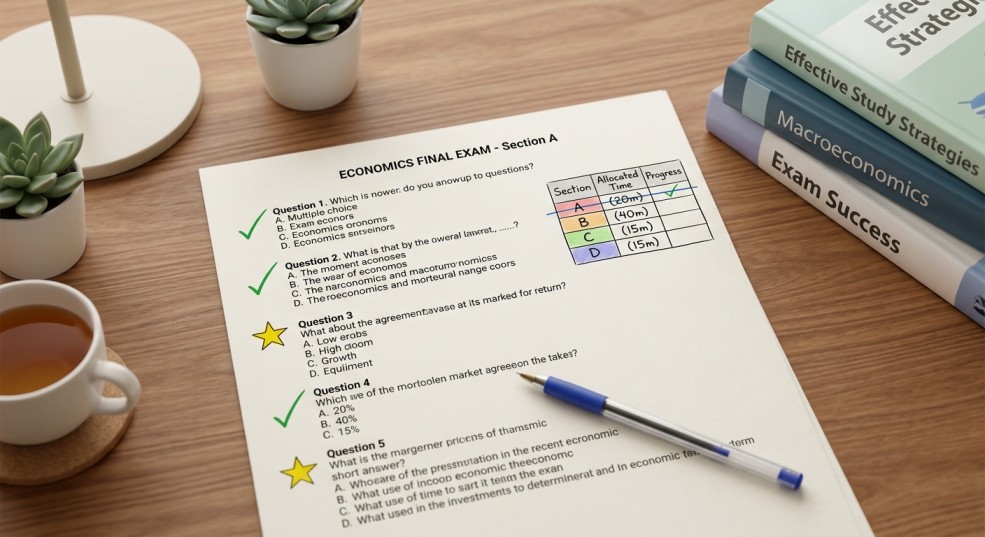
Step 3: Mark Difficult Questions
If a question feels confusing:
- Put a small mark or star
- Leave space if needed
- Move on immediately
👉 Do NOT waste time here
Step 4: Come Back Later
After completing easy questions:
- Return to marked questions
- Use remaining time wisely
Step 5: Final Review
If time remains:
- Check structure
- Fix small mistakes
- Improve presentation
Why This Strategy Works So Well
1. Maximizes Attempted Questions
More attempted questions = more chances of scoring.
2. Reduces Stress
You are never stuck in one place for too long.
3. Improves Speed
Your brain stays in “flow mode” instead of panic mode.
4. Ensures Full Paper Coverage
No question is completely ignored.
Common Mistakes Students Make Without This Strategy
1. Getting Stuck Early
One hard question ruins the entire paper timing.
2. Leaving Easy Questions for Later
Sometimes students never reach them.
3. Uneven Time Distribution
Too much time on one section, less on others.
4. Last-Minute Rush
Incomplete answers due to poor planning.
Real Exam Scenario Example
Let’s understand practically:
You have a 3-hour paper with 10 questions.
Without strategy:
- You spend 25 minutes on Q1
- 20 minutes on Q2
- Panic starts
- Last 3 questions rushed
👉 Result: lost marks
With Mark and Move:
- Q1 (easy) → 10 minutes
- Q2 (easy) → 10 minutes
- Q3 (difficult) → marked & skipped
- Remaining questions completed first
👉 Result: full coverage + better score
How Top Students Use This Strategy
High scorers don’t write differently—they manage differently.
They:
- Never stay stuck on one question
- Prioritize scoring opportunities
- Keep calm under pressure
- Treat exam like a system, not a struggle
👉 Their secret is not intelligence—it is strategy.
How to Train Yourself Before Exams
1. Practice Timed Papers
Simulate exam conditions at home.
2. Set Internal Limits
Example:
- MCQs → max 1 minute each
- Short questions → 3–5 minutes
3. Develop Decision Speed
Train yourself to quickly decide:
✔ Attempt now
✔ Skip and return
4. Avoid Perfection Habit
Aim for complete answers, not perfect ones
Mindset Shift You Need
Instead of thinking:
❌ “Mujhe har question perfect banana hai”
Think:
✔ “Mujhe maximum marks collect karne hain”
Exams are not about beauty of answers—they are about efficiency.
When NOT to Use Mark and Move
Although powerful, this strategy needs balance.
Avoid misuse:
- Don’t skip too many questions too quickly
- Don’t ignore questions you can solve with little effort
- Don’t panic-skip
👉 Use judgment, not guesswork
Final Benefits Summary
If you master this strategy, you will:
- Attempt more questions
- Waste less time
- Reduce exam stress
- Improve overall score
- Stay mentally stable during paper
Conclusion: Smart Students Don’t Just Study—They Strategize
Time management is the invisible skill that separates average students from top performers. The “Mark and Move” strategy is not complicated, but it is extremely powerful when used correctly.
Exams will always have easy and difficult questions, but your success depends on how you handle both.
👉 Don’t get trapped in one question when the whole paper is waiting for you.
👉 Don’t lose marks because of hesitation.
👉 Don’t aim for perfection—aim for completion.
At the end of the day, the student who manages time wisely always scores higher than the student who only manages knowledge.
Final Line to Remember
👉 “In exams, it’s not about how long you think on one question—it’s about how many questions you complete smartly.”
📘 TIME MANAGEMENT IN THE EXAM HALL
⏱️ THE “MARK AND MOVE” STRATEGY (TOPPER FAQ GUIDE)
❓ FAQ 1: WHAT IS THE “MARK AND MOVE” STRATEGY?
✅ ANSWER:
IT IS A TIME MANAGEMENT METHOD USED DURING EXAMS.
👉 YOU:
- ATTEMPT EASY QUESTIONS FIRST ✔️
- MARK DIFFICULT ONES FOR LATER ❗
- KEEP MOVING THROUGH THE PAPER ⏱️
💡 GOAL = MAXIMUM ATTEMPTS IN MINIMUM TIME
❓ FAQ 2: WHY IS “MARK AND MOVE” IMPORTANT?
⚠️ ANSWER:
BECAUSE MANY STUDENTS LOSE MARKS NOT DUE TO LACK OF KNOWLEDGE — BUT DUE TO POOR TIME MANAGEMENT.
🧠 IT HELPS YOU:
- AVOID GETTING STUCK ❌
- COMPLETE FULL PAPER ✔️
- REDUCE EXAM PANIC 😵
- MAXIMIZE SCORE 📈
❓ FAQ 3: HOW DOES THE STRATEGY WORK STEP BY STEP?
🪜 ANSWER:
🔥 STEP 1:
READ FULL PAPER QUICKLY 👀
🔥 STEP 2:
ANSWER EASY QUESTIONS FIRST ✔️
🔥 STEP 3:
MARK DIFFICULT QUESTIONS ❗ AND SKIP
🔥 STEP 4:
RETURN TO MARKED QUESTIONS LATER 🔁
💡 THIS PREVENTS TIME WASTE
❓ FAQ 4: WHAT SHOULD I DO WITH DIFFICULT QUESTIONS?
❓ ANSWER:
DON’T PANIC OR STOP.
👉 INSTEAD:
- MARK THEM CLEARLY ❗
- MOVE TO NEXT QUESTION ⏱️
- COME BACK AFTER COMPLETING EASY ONES
💡 NEVER LET ONE QUESTION CONTROL YOUR PAPER
❓ FAQ 5: WHY DO STUDENTS FAIL TO COMPLETE PAPERS?
❌ ANSWER:
- THEY GET STUCK ON ONE QUESTION 😵
- THEY SPEND TOO MUCH TIME THINKING
- THEY IGNORE EASY QUESTIONS LATER
- POOR TIME PLANNING ⏱️
💡 ONE QUESTION CAN RUIN FULL PAPER IF NOT HANDLED SMARTLY
❓ FAQ 6: HOW DOES “MARK AND MOVE” INCREASE SCORE?
📈 ANSWER:
👉 IT HELPS YOU:
- ATTEMPT MORE QUESTIONS ✔️
- REDUCE BLANK ANSWERS ❌
- UTILIZE FULL TIME EFFECTIVELY ⏱️
- IMPROVE FINAL SCORE SIGNIFICANTLY 📘
❓ FAQ 7: WHAT IS THE BEST ORDER TO ATTEMPT PAPER?
🧠 ANSWER:
🎯 BEST ORDER:
- EASY QUESTIONS FIRST ✔️
- MEDIUM QUESTIONS NEXT ⚖️
- DIFFICULT QUESTIONS LAST ❗
💡 THIS BUILDS CONFIDENCE AND SAVES TIME
❓ FAQ 8: WHAT IS THE BIGGEST MISTAKE STUDENTS MAKE?
❌ ANSWER:
- TRYING QUESTIONS IN ORDER ONLY
- WASTING TIME ON ONE HARD QUESTION
- NOT MARKING SKIPPED QUESTIONS
- PANICKING DURING PAPER 😵
🎯 FINAL TOPPER TIP:
👉 “IN EXAMS, SMART MOVEMENT IS MORE IMPORTANT THAN HARD THINKING — MARK AND MOVE IS THE KEY TO FULL PAPER ATTEMPT.”
IF YOU WANT, I CAN ALSO MAKE:
🔥 “EXAM TIME BREAKDOWN STRATEGY (MINUTE-BY-MINUTE)”
🔥 “HOW TO DECIDE EASY VS HARD QUESTIONS IN SECONDS”
🔥 “TOPPER PAPER ATTEMPTING SEQUENCE PLAN”