
Introduction
The morning of an exam can feel heavier than the exam itself. Even if you are well prepared, something strange often happens: your mind starts to feel cloudy, small doubts appear, and unnecessary panic builds up. Many students describe it as “brain fog”—a state where you know you studied, but you cannot think clearly.
The truth is simple: exam morning is not about learning new things, it is about protecting your calm, energy, and focus. What you do in the few hours before the exam can strongly influence your performance inside the hall.
Top performers don’t rely only on study. They follow a set of quiet, controlled habits called exam morning rituals that keep their mind stable and sharp.
This guide explains exactly how to build those rituals so you can walk into your exam with clarity instead of stress.
Why Exam Morning Panic Happens
Before fixing the problem, you need to understand it.
Last-minute panic usually comes from:
- Overthinking what you didn’t revise
- Fear of forgetting everything
- Lack of sleep or irregular routine
- Pressure from expectations
- Last-minute heavy studying
When your brain feels overloaded, it enters a mild stress response. This reduces focus and creates brain fog, where thoughts feel slow and scattered.
Bold truth:
Brain fog is not lack of knowledge—it is overload of pressure.
The Golden Rule of Exam Morning
There is one rule that separates calm students from panicked ones:
👉 Do not try to learn new things on exam morning
Your brain is not designed for heavy learning at that time. It is designed for recall and stability.
Instead of adding information, your goal should be to:
- Calm your mind
- Activate confidence
- Avoid stress triggers
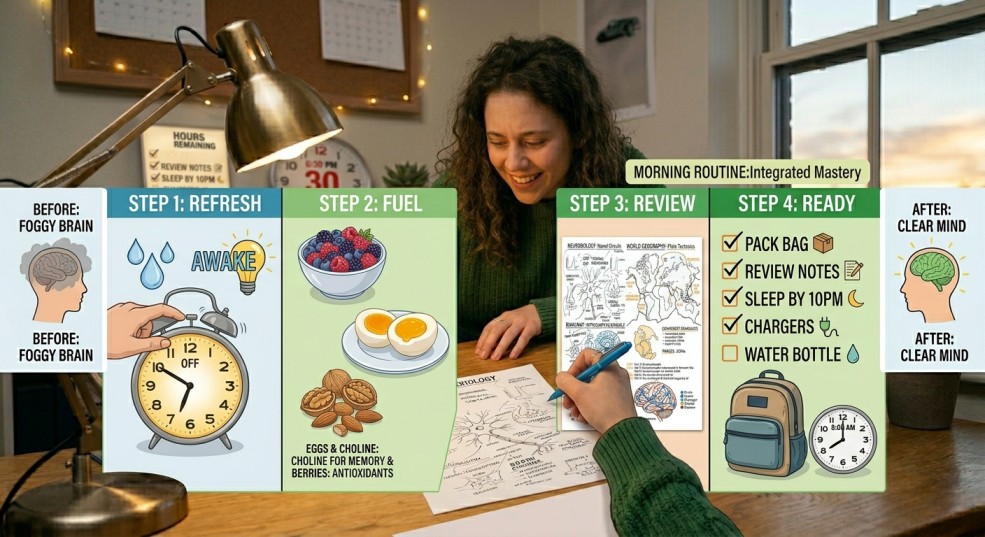
Step 1: Wake Up at a Stable Time
Waking up too late or too early can disturb your mental rhythm.
Try to:
- Wake up at least 2–3 hours before the exam
- Avoid rushing immediately after waking up
- Keep your routine consistent
A stable morning schedule tells your brain:
“Today is normal. There is no emergency.”
Step 2: Avoid Phone Overload
One of the biggest causes of exam panic is early morning phone use.
Avoid:
- Social media scrolling
- Checking difficult questions online
- Reading stressful messages
Instead, keep your environment quiet and focused.
Bold insight:
What you see first in the morning shapes your entire mental state.
Step 3: Light Revision Only (Not Heavy Study)
Revision on exam morning should be:
- Short
- Simple
- Familiar
Focus on:
- Key formulas
- Important definitions
- Short notes
- Diagrams or summaries
Avoid:
- Long chapters
- Complex problems
- New topics
The goal is to refresh memory, not overload it.
Step 4: Eat a Light and Balanced Breakfast
Food affects brain performance more than most students realize.
Good options include:
- Light breakfast
- Fruits or simple meals
- Water or juice
Avoid:
- Heavy oily food
- Excess sugar
- Skipping breakfast
A heavy stomach can slow thinking, while no food can increase anxiety.
Step 5: Control Internal Dialogue
Your thoughts in the morning shape your exam mindset.
Common negative thoughts:
- “I forgot everything”
- “What if I fail?”
- “I didn’t study enough”
Replace them with:
- “I have prepared well”
- “I will do my best calmly”
- “I will start step by step”
Bold mindset shift:
Your thoughts before the exam become your performance inside the exam.
Step 6: Avoid Last-Minute Studying Panic
Many students try to study everything in the last hour.
This creates:
- Confusion
- Anxiety
- Memory blockage
Instead, trust your preparation.
Remember:
👉 What you know is already stored. Panic cannot improve it.
Step 7: Do a Calm Mental Warm-Up
Just like athletes warm up their body, you should warm up your brain.
Try:
- Deep breathing for 1–2 minutes
- Simple mental recall of formulas
- Light stretching
This improves blood flow and reduces tension.
Step 8: Keep Everything Ready in Advance
One major source of stress is last-minute searching.
Prepare the night before:
- Admit card
- Pens and stationery
- Water bottle
- Required documents
On exam morning, avoid running around.
Bold rule:
A calm morning starts the night before.
Step 9: Avoid Comparison With Others
On exam day, you may hear:
- Friends discussing topics
- Students revising loudly
- Fear-based conversations
Avoid engaging in these.
Comparison leads to unnecessary panic.
Focus only on your own preparation.
Step 10: Reach the Exam Center Early
Arriving early helps you:
- Adjust to the environment
- Reduce travel stress
- Avoid last-minute rush
Rushing creates mental pressure even before the exam starts.
Step 11: Stay Away From Negative Talk
In exam halls or outside, students often say things like:
- “Paper is very difficult”
- “I didn’t study anything”
- “I am going to fail”
Do not absorb this energy.
Protect your mindset.
Step 12: Use Controlled Breathing Before Entering
Right before the exam:
- Inhale slowly
- Hold for a few seconds
- Exhale gently
Repeat a few times.
This reduces heart rate and clears mental fog.
How to Recognize Brain Fog Before Exam
You may feel:
- Slow thinking
- Memory blockage
- Nervousness
- Confusion about simple things
If this happens, do not panic.
It is temporary and reversible.
Quick Fix for Brain Fog
If your mind feels blank:
- Pause for a moment
- Take deep breaths
- Focus on one simple thought
- Start with easy recall
Clarity returns once pressure reduces.
What Toppers Do Differently
Top students don’t do extra studying in the morning. Instead, they:
- Stay calm
- Revise lightly
- Avoid stress triggers
- Trust their preparation
- Enter the exam mentally stable
Their strength is not last-minute effort—it is mental control.
Common Mistakes to Avoid
❌ Studying too much in the morning
❌ Skipping breakfast
❌ Using phone excessively
❌ Panicking about revision
❌ Listening to negative discussions
❌ Rushing to the exam hall
Each of these increases stress unnecessarily.
Final Morning Mindset
Your goal is not to become perfect in the morning.
Your goal is to become:
- Calm
- Focused
- Confident
- Ready
Conclusion
Exam morning is not about preparation—it is about mental stability. Most students lose clarity not because they lack knowledge, but because they allow panic to take control in the final hours.
When you follow simple rituals like light revision, calm breathing, proper breakfast, and avoiding negative influence, your brain stays clear and active.
Remember this:
You don’t need more information on exam morning—you need more control.
A peaceful mind performs better than a pressured one. If you enter the exam hall calm and focused, your preparation will naturally translate into performance.
Because success in exams often starts not with the first question—but with the first calm morning.
📘 EXAM MORNING RITUALS
🧠 HOW TO AVOID LAST-MINUTE PANIC + BRAIN FOG (TOPPER FAQ GUIDE)
❓ FAQ 1: WHAT SHOULD I DO FIRST THING IN THE EXAM MORNING?
✅ ANSWER:
START CALMLY — NOT RUSHED.
👉 FOLLOW THIS SIMPLE FLOW:
- WAKE UP EARLY ⏰
- DRINK WATER 💧
- DO LIGHT REVISION (NOT NEW TOPICS) 📖
- STAY AWAY FROM PANIC TALK ❌
💡 YOUR BRAIN NEEDS CALM ENERGY, NOT CHAOS.
❓ FAQ 2: HOW DO I AVOID PANIC BEFORE THE EXAM?
✅ ANSWER:
PANIC COMES FROM OVERTHINKING.
🧠 SOLUTION:
- AVOID LAST-MINUTE HEAVY STUDY
- STOP COMPARING WITH OTHERS
- TRUST YOUR PREPARATION
- TAKE DEEP BREATHS (4-7-8 METHOD)
👉 PANIC IS EMOTION — NOT REAL KNOWLEDGE PROBLEM.
❓ FAQ 3: WHAT IS BRAIN FOG AND WHY DOES IT HAPPEN?
❓ ANSWER:
BRAIN FOG MEANS:
- SLOW THINKING
- FORGETTING EASY THINGS
- CONFUSION DURING EXAM
⚠️ REASONS:
- LACK OF SLEEP 😴
- OVERSTUDYING AT NIGHT 📚
- STRESS 😵
- NO BREAKFAST 🍽️
❓ FAQ 4: WHAT SHOULD I EAT BEFORE EXAM?
✅ ANSWER:
EAT LIGHT BUT ENERGY-BOOSTING FOOD.
🍽️ BEST OPTIONS:
- BANANA 🍌
- EGGS 🥚
- TOAST / LIGHT BREAD
- WATER 💧
❌ AVOID:
- HEAVY OILY FOOD
- TOO MUCH TEA/COFFEE
- EMPTY STOMACH
❓ FAQ 5: SHOULD I STUDY JUST BEFORE ENTERING EXAM HALL?
❌ ANSWER:
NO — THAT IS A BIG MISTAKE.
👉 IT CAUSES:
- CONFUSION
- DOUBT
- MEMORY OVERLOAD
✅ INSTEAD:
- QUICK FORMULA REVISION ONLY
- POSITIVE SELF TALK
- RELAX YOUR MIND
❓ FAQ 6: HOW DO I STAY CALM INSIDE THE EXAM HALL?
✅ ANSWER:
🧠 FOLLOW THIS:
- READ PAPER SLOWLY FIRST 5 MINUTES
- START WITH EASY QUESTIONS ✔️
- DON’T LOOK AT OTHERS ❌
- MANAGE TIME SMARTLY ⏱️
💡 CALM START = STRONG PERFORMANCE
❓ FAQ 7: WHAT TO DO IF I FORGET EVERYTHING IN EXAM?
❓ ANSWER:
DON’T PANIC — THIS IS TEMPORARY.
🧠 DO THIS:
- SKIP QUESTION AND MOVE AHEAD
- BREATHE DEEPLY
- RETURN LATER
- YOUR MEMORY WILL RECOVER NATURALLY
❓ FAQ 8: WHAT IS THE BEST EXAM MORNING ROUTINE?
🌅 ANSWER:
🪜 PERFECT ROUTINE:
- WAKE UP EARLY
- LIGHT REVISION (30–45 MIN MAX)
- FRESH BREAKFAST
- PACK ALL MATERIALS
- LEAVE EARLY FOR CENTER
- STAY POSITIVE
🎯 FINAL TOPPER TIP:
👉 “EXAM IS NOT JUST KNOWLEDGE TEST — IT IS CALMNESS + CONTROL TEST.”
IF YOU WANT, I CAN ALSO MAKE:
🔥 “EXAM CENTER STRATEGY (FIRST 10 MIN RULE)”
🔥 “HOW TO BOOST MEMORY BEFORE PAPER”
🔥 “FULL NIGHT BEFORE EXAM ROUTINE”