
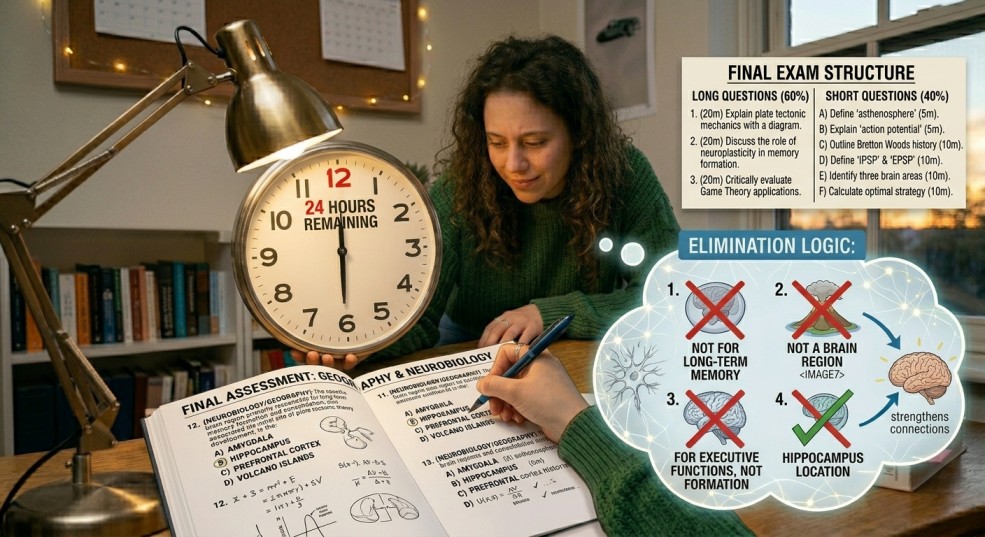

Introduction
Mathematics exams are often considered the most time-sensitive and pressure-heavy papers. Even students who understand concepts well sometimes struggle to complete the paper on time or make careless mistakes due to poor time management.
The truth is simple: Math is not just about solving problems—it is about managing time while solving them.
Top students don’t necessarily solve faster because they are smarter. They solve faster because they follow a structured exam strategy that balances short questions, long questions, accuracy, and time control.
In this detailed guide, you will learn exactly how to approach a math exam like a topper, manage time efficiently, and maximize your score without panic or confusion.
Why Time Management Matters in Math Exams
Unlike theory-based subjects, math exams are:
- Step-heavy
- Time-consuming
- Accuracy-dependent
- Pressure-intensive
You may know how to solve every question, but if you fail to manage time, you may leave questions incomplete or make avoidable mistakes.
Bold truth:
In math exams, time is as important as knowledge.
Even a small delay in one question can affect your performance in the entire paper.
Understanding the Structure of a Math Paper
Before entering the exam hall, you must understand the paper pattern:
- Short questions (quick, direct, 1–5 marks)
- Long questions (step-based, 8–10+ marks)
- Problem-solving sections (multi-step calculations)
Each section requires a different time strategy.
The First 5–10 Minutes: Paper Strategy Phase
The exam does not start with writing—it starts with planning.
During the first few minutes:
1. Scan the Entire Paper
Quickly go through:
- All sections
- Question difficulty
- Mark distribution
This helps your brain create a mental roadmap.
2. Identify Easy Questions First
Mark mentally:
- “I can do this quickly”
- “This will take time”
- “I am unsure about this”
3. Plan Your Order
Top students don’t solve in sequence—they solve in strategy order.
Bold strategy:
Easy → Moderate → Difficult
Step 1: Start with Short Questions (Confidence Building Phase)
Short questions are your scoring foundation.
Why start here?
- Quick to solve
- Boost confidence
- Save time for long questions later
How to Handle Short Questions Efficiently
- Don’t over-explain
- Write direct steps
- Avoid unnecessary calculations
- Keep handwriting neat but fast
Each short question should ideally take 1–3 minutes.
Common Mistake Students Make
❌ Spending too much time perfecting short answers
Remember:
Short questions are speed points, not detail tests.
Step 2: Move to Moderate Questions (Momentum Phase)
After short questions, your brain is warmed up.
Now move to:
- Medium difficulty problems
- 5–7 mark questions
At this stage:
- Your confidence is higher
- Your thinking is active
- Your speed improves naturally
Time Allocation Strategy
Spend:
- 4–7 minutes per moderate question
If stuck:
- Skip and move forward
- Return later if time allows
Step 3: Long Questions (High Marks but Time-Heavy)
Long questions are the most important part of math exams.
They carry high marks but require:
- Step-by-step solving
- Clear presentation
- Logical sequence
How to Approach Long Questions Smartly
1. Read the Question Twice
Understand:
- What is given
- What is required
- Which formula or method applies
2. Write Known Formulas First
This helps your brain start working even if you feel stuck.
3. Break the Problem into Steps
Don’t try to solve everything in your head.
Divide into:
- Step 1
- Step 2
- Step 3
4. Show Every Step Clearly
Even if the final answer is wrong, steps can still earn marks.
5. Keep Moving Forward
Don’t get stuck on one long question too long.
Bold rule:
One question should not destroy your entire paper strategy.
Time Distribution Strategy (Very Important)
A smart time plan looks like this:
- Short questions: 25–30% time
- Medium questions: 30–35% time
- Long questions: 35–40% time
This balance ensures you don’t run out of time at the end.
Skipping Strategy: The Secret of Topper Performance
One of the biggest secrets of toppers is:
👉 They don’t waste time stuck on one question
If a question takes too long:
- Leave space
- Move forward
- Return later
This prevents panic and ensures maximum attempt coverage.
Common Time-Wasting Mistakes in Math Exams
Avoid these errors:
1. Overthinking Easy Questions
Many students doubt simple answers and waste time.
2. Starting with Difficult Questions
This leads to early panic and time loss.
3. Poor Writing Speed
Slow writing reduces overall attempt capacity.
4. Rechecking Every Step Repeatedly
Rechecking is good—but not during solving.
5. Getting Stuck Emotionally
Stress leads to mental blocks.
Smart Techniques Used by Toppers
Top students follow hidden strategies:
1. First Attempt Rule
Solve everything you know in the first round.
2. Second Round Revision
Go back only to skipped questions.
3. Quick Decision Making
If a question is unclear in 30–60 seconds:
👉 Skip it temporarily
4. Maintain Flow State
Don’t break momentum once you start solving easily.
How to Stay Calm During the Exam
Math exams create pressure easily.
To stay calm:
- Take deep breaths before starting
- Don’t panic if stuck
- Move forward strategically
Bold mindset:
Calm mind solves faster than stressed mind.
Presentation Matters in Math Exams
Even in math, presentation affects marks.
Always:
- Write steps clearly
- Box final answers
- Avoid messy calculations
- Label diagrams properly
Last 10 Minutes Strategy
The final minutes are critical.
Do this:
- Check skipped questions
- Verify final answers
- Fix calculation errors
- Ensure all questions attempted
What NOT to Do in Final Minutes
❌ Don’t start new long questions
❌ Don’t panic solve randomly
❌ Don’t rewrite everything
Focus only on correction and completion
Mental Formula for Success in Math Exams
Top students follow this mindset:
👉 “Easy first, accuracy second, difficult last”
Instead of:
❌ “Solve everything in order”
Practice Strategy Before Exams
To improve exam performance:
- Solve past papers with timer
- Practice mixed difficulty questions
- Simulate real exam conditions
- Improve speed gradually
Final Exam Checklist
Before submitting:
✔ Attempted all easy questions
✔ Used time wisely
✔ Checked calculations
✔ Verified final answers
✔ Maintained neat presentation
Conclusion
A math exam is not just a test of knowledge—it is a test of planning, speed, and decision-making. Students who understand concepts but fail to manage time often lose marks, while those with average preparation but strong strategy perform better.
The key to success is simple: start smart, move strategically, and never get stuck for too long.
Short questions build confidence, long questions build marks, but time management builds success.
If you follow a structured approach, control your speed, and avoid panic, you will not only complete your paper on time but also improve accuracy significantly.
Because in math exams, the topper is not the one who solves everything—but the one who solves the right things at the right time.
➗ HOW TO APPROACH A MATH EXAM (TIME MANAGEMENT FOR LONG & SHORT QUESTIONS)
(FAQ STYLE — BIG FORMAT + CLEAR STRATEGY)
❓ Q1: MATH EXAM ME SAB SE PEHLA STEP KYA HONA CHAHIYE?
✔ PAPER MILTE HI PANIC NA KARO
✔ 2–5 MINUTES ME PURA PAPER SCAN KARO
✔ EASY + MEDIUM + HARD QUESTIONS IDENTIFY KARO
👉 SMART STUDENT PEHLE “WINNING QUESTIONS” PICK KARTA HAI
❓ Q2: TIME MANAGEMENT KA BASIC RULE KYA HAI?
✔ HAR QUESTION KO TIME LIMIT DO
✔ EXTRA TIME EK QUESTION PE MAT WASTE KARO
👉 SIMPLE FORMULA:
🟢 EASY = FAST
🟡 MEDIUM = CONTROLLED
🔴 HARD = LAST
❓ Q3: SHORT QUESTIONS KO KAISE HANDLE KAREIN?
✔ PEHLE SHORT QUESTIONS ATTEMPT KARO
✔ KYUN? KYUN KE YEH QUICK MARKS DETE HAIN
👉 STRATEGY:
- 1–2 MIN PER QUESTION
- DIRECT FORMULA APPLY
- LONG STEPS AVOID
❓ Q4: LONG QUESTIONS KO KAISE SOLVE KAREIN?
✔ STEP-BY-STEP SOLVE KARO
✔ FORMULA CLEAR LIKHO PEHLE
✔ DIAGRAMS (AGAR HAIN) ZAROOR BANAO
👉 TIME RULE:
⏱ 8–15 MIN PER LONG QUESTION (LEVEL DEPEND KARTA HAI)
❓ Q5: AGAR QUESTION NA AAYE TO KYA KARNA CHAHIYE?
❌ PANIC NAHI
✔ NEXT QUESTION PE MOVE KARO
✔ LATER WAPIS AANA BETTER HAI
👉 SMART MOVE = TIME SAVE + MARKS RECOVERY
❓ Q6: CALCULATIONS ME MISTAKES SE KAISE BACHAIN?
✔ STEP CLEAR LIKHO
✔ MENTAL CALCULATION PE BLIND TRUST MAT KARO
✔ LAST ME QUICK CHECK KARO
❓ Q7: FORMULAS YAAD NA HO TO KYA KAREIN?
✔ EXAM SE PEHLE FORMULA SHEET REVISE KARO
✔ COMMON FORMULAS KO PRACTICE SE STRONG KARO
✔ DERIVATION BASICS YAAD RAKHO
❓ Q8: PAPER COMPLETE NA HO TO KYA KARNA CHAHIYE?
✔ PEHLE EASY QUESTIONS COMPLETE KARO
✔ PARTIAL MARKS KO IGNORE MAT KARO
✔ STEPS LIKHNA MAT CHHODO
❓ Q9: FINAL 10 MINUTES ME KYA KARNA CHAHIYE?
✔ ANSWERS QUICK CHECK
✔ UNITS VERIFY
✔ CALCULATION ERRORS SEARCH
✔ BLANK QUESTIONS FILL KARO
🎯 FINAL STRATEGY (MATH EXAM SUCCESS FORMULA)
👉 SCAN → SHORT QUESTIONS → LONG QUESTIONS → REVIEW
💡 EXTRA TIP
✔ MATH EXAM ME SPEED + ACCURACY DONO ZAROORI HAIN
✔ SIRF FAST NAHI, SIRF ACCURATE BHI NAHI — BALANCE CHAHIYE