
Introduction
Most students believe that studying one subject for long hours is the most effective way to prepare for exams. It feels logical—focus on one topic, finish it completely, and then move to the next. But research in learning science shows something surprising: this method is not always the best for long-term memory and exam performance.
There is a smarter technique called interleaving, and it is one of the most powerful study strategies used by toppers and high achievers.
Interleaving means mixing different subjects or topics in a single study session instead of studying one subject for hours continuously.
This article explains why studying one subject all day is less effective, how interleaving works, and how you can apply it to improve your learning, retention, and exam scores.
What is Interleaving? (Simple Explanation)
Interleaving is a study technique where you:
- Switch between different subjects
- Mix different types of problems
- Alternate between topics during study sessions
Instead of:
👉 Studying Math for 3 hours straight
You do:
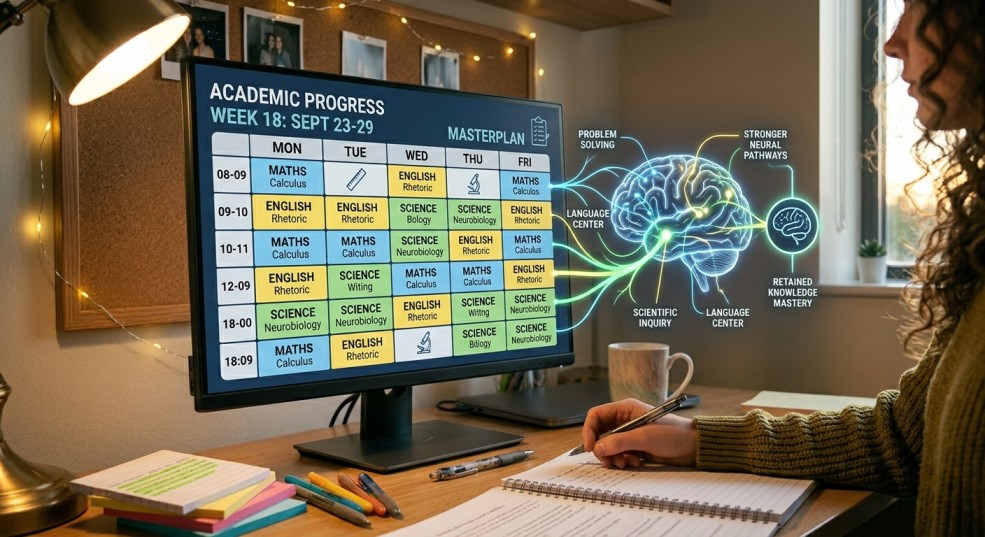
👉 Math → English → Science → Math again → History
This switching forces your brain to constantly adapt, which strengthens learning.
Bold concept:
Interleaving is about switching smartly, not studying randomly.
Why Studying One Subject All Day Feels Easy but Fails in Exams
When you study only one subject for long hours:
- Your brain gets used to one type of thinking
- You start recognizing patterns instead of understanding concepts
- You feel confident, but it is often “false confidence”
This is called blocked practice, and it gives an illusion of mastery.
The problem appears in exams when:
- Questions are mixed
- Concepts are not in sequence
- You need to switch thinking quickly
Students who only use blocked study often struggle to recall under pressure.
How Interleaving Improves Memory
Interleaving works because it forces your brain to:
- Compare concepts
- Identify differences
- Strengthen retrieval ability
- Reduce confusion between topics
Instead of memorizing in isolation, your brain learns to connect ideas.
For example:
- Math formula vs Physics formula
- Grammar rules vs writing skills
- Similar historical events
This comparison strengthens long-term memory.
The Science Behind Interleaving
Research in cognitive psychology shows that interleaving improves:
- Memory retention
- Problem-solving ability
- Concept understanding
- Exam performance
When you switch subjects, your brain must “reload” information repeatedly. This effort is what strengthens memory pathways.
Bold insight:
Difficulty during study = stronger memory during exams.
If studying feels slightly harder, it often means learning is deeper.
Why Blocking Study Feels Comfortable but Is Weak
Studying one subject continuously feels:
- Easy
- Smooth
- Comfortable
But this comfort is misleading.
Your brain is not being challenged enough. It becomes passive instead of active.
Blocked study creates:
- Overconfidence
- Poor retention
- Weak recall under pressure
How Interleaving Trains Your Brain for Exams
Exams are not organized by subject blocks. Instead:
- Questions are mixed
- Thinking must switch quickly
- Memory must be flexible
Interleaving prepares your brain for exactly this environment.
It trains you to:
- Shift attention quickly
- Recall information under pressure
- Avoid confusion between topics
Bold truth:
Exams reward flexibility, not repetition.
Simple Example of Interleaving
Instead of studying like this:
- 2 hours Math
- 2 hours Physics
- 2 hours Chemistry
You study like this:
- 45 min Math
- 45 min Physics
- 45 min Chemistry
- Repeat cycle
This keeps your brain active and engaged.
Best Way to Use Interleaving in Daily Study
Step 1: Choose 3–4 Subjects
Pick subjects you study regularly.
Step 2: Divide Study Time into Blocks
Example:
- 30–45 minute sessions
- Short breaks in between
Step 3: Mix Subjects Intentionally
Rotate like:
- Math → English → Science → Math
Step 4: Focus on Active Learning
During each block:
- Solve questions
- Recall formulas
- Practice problems
Avoid passive reading.
Interleaving vs Traditional Study
| Traditional Study | Interleaving |
|---|---|
| One subject at a time | Multiple subjects mixed |
| Easy and smooth | Slightly challenging |
| Good short-term memory | Strong long-term memory |
| Weak exam switching ability | Strong exam adaptability |
Common Mistakes Students Make with Interleaving
1. Switching Too Frequently
Jumping every 5 minutes reduces focus.
2. Mixing Without Structure
Random switching creates confusion.
3. Not Revisiting Topics
Interleaving works only with repetition.
4. Avoiding Difficult Subjects
Students often avoid tough topics instead of mixing them.
When Interleaving Works Best
Interleaving is most effective for:
- Exam preparation
- Problem-solving subjects
- Memory-based learning
- Competitive exams
It is especially powerful when exams require quick thinking across different topics.
Why Interleaving Feels Difficult at First
At the beginning, interleaving feels:
- Confusing
- Slower
- Less comfortable
But this is actually a good sign.
Your brain is being challenged to think harder, which improves learning quality.
Bold insight:
If it feels slightly difficult, it is working.
How Toppers Use Interleaving Without Realizing It
High-performing students naturally:
- Switch subjects during revision
- Mix practice questions
- Review multiple topics daily
They don’t stick to one subject for too long because they understand the value of mental flexibility.
Interleaving for Revision
During revision, instead of:
- Revising one full chapter repeatedly
Use:
- Quick revision of multiple chapters
- Mixed question practice
- Random topic recall
This strengthens memory faster.
Interleaving and Exam Confidence
One major benefit of interleaving is improved confidence.
Because you practice switching topics, you feel:
- Less confused in exams
- More prepared for unexpected questions
- Better at recalling under pressure
Simple Daily Interleaving Plan
A balanced schedule can look like:
- Morning: Math + English
- Afternoon: Science + History
- Evening: Revision mix
This keeps learning active throughout the day.
Final Mindset Shift
Instead of thinking:
👉 “I should finish one subject completely today”
Think:
👉 “I should train my brain to switch and adapt.”
This shift improves performance significantly.
Conclusion
Studying one subject all day may feel comfortable, but it does not prepare your brain for real exam conditions. Exams require flexibility, quick thinking, and strong recall ability.
Interleaving builds exactly these skills by mixing subjects and forcing your brain to switch between ideas. Although it may feel slightly difficult at first, it leads to stronger memory and better long-term performance.
If you want to study smarter instead of just longer, interleaving is one of the most powerful strategies you can use.
Because in real exams, success does not come from studying one thing deeply—it comes from switching knowledge quickly and accurately when it matters most.
🧠 THE POWER OF INTERLEAVING (WHY YOU SHOULDN’T STUDY ONE SUBJECT ALL DAY)
(FAQ STYLE — BIG FORMAT + CLEAR EXPLANATION)
❓ Q1: INTERLEAVING HAI KYA?
✔ Interleaving ka matlab hai different subjects ya topics ko mix karke parhna
✔ Example: Math → English → Science → Math
👉 EK HI SUBJECT KO CONTINUOUS PARHNA = BLOCK STUDY
👉 MIX KARNA = INTERLEAVING
❓ Q2: EK HI SUBJECT KO POORA DIN PARHNA GALAT KYUN HAI?
❌ Brain quickly “bor ho jata hai”
❌ Memory weak ho jati hai
❌ Focus dheere dheere kam hota hai
👉 RESULT: “I read a lot, but remember little”
❓ Q3: INTERLEAVING KYUN BETTER HAI?
✔ Brain ko active rakhta hai
✔ Memory zyada strong hoti hai
✔ Problem-solving better hota hai
✔ Real exam conditions jaisa practice hota hai
👉 MIXED PRACTICE = STRONG LEARNING
❓ Q4: INTERLEAVING KA SIMPLE EXAMPLE KYA HAI?
✔ 1 hour schedule:
- 20 min Math
- 20 min English
- 20 min Biology
👉 NEXT DAY: order change kar do
👉 Brain har topic ko “fresh” treat karta hai
❓ Q5: BLOCK STUDY VS INTERLEAVING DIFFERENCE?
🔴 BLOCK STUDY
- Ek hi subject pura din
- Repetition zyada
- Bore + low retention
🟢 INTERLEAVING
- Multiple subjects mix
- Active brain
- Better long-term memory
❓ Q6: INTERLEAVING KA BEST USE KAHA HOTA HAI?
✔ Exam preparation
✔ Revision sessions
✔ Problem-solving subjects (Math, Physics)
✔ Language learning
❓ Q7: INTERLEAVING KA IDEAL SCHEDULE KYA HAI?
👉 Example daily plan:
✔ Morning: Math + Science
✔ Afternoon: English + History
✔ Evening: Revision mix
👉 SHORT SESSIONS = HIGH FOCUS
❓ Q8: KYA INTERLEAVING HAR STUDENT KE LIYE HAI?
✔ YES, LEKIN ADAPT KARNA HOTA HAI
✔ Beginners ko thoda slow start karna chahiye
✔ Consistency important hai
❓ Q9: COMMON MISTAKES KYA HOTI HAIN?
❌ RANDOM STUDY WITHOUT PLAN
❌ TOO MANY SUBJECTS EK SAATH
❌ REVISION IGNORE KARNA
👉 INTERLEAVING = SMART MIX, NOT CHAOS
❓ Q10: FINAL RESULT KYA HOTA HAI?
✔ Better understanding
✔ Strong memory retention
✔ Exam me fast recall
✔ Less boredom, more productivity
🎯 FINAL FORMULA
👉 BLOCK STUDY = SHORT TERM FEELING OF PROGRESS
👉 INTERLEAVING = LONG TERM STRONG MEMORY + HIGH MARKS
💡 FINAL TIP
👉 SMART STUDENT “EK SUBJECT KO POORA DIN” NAHI PARHTA
👉 WO SUBJECTS KO MIX KARKAY BRAIN KO ACTIVE RAKHTA HAI